Guitar tunings: the notes and what they are for
A tab is only right for the tuning it was written in. Here are the standard tuning, the alternate tunings you will meet most often, their notes from the low string up, what each is good for, and how to set them in the editor so the tab and the playback match.
Updated October 25, 2026 · by the SimpleNotation team
Standard tuning: E A D G B E
From the thickest string to the thinnest: E, A, D, G, B, E. The intervals between the strings are a fourth each, except between G and B, which is a major third; that one odd gap is why chord shapes look the way they do. A way to remember the order: Eddie Ate Dynamite, Good Bye Eddie. The high E is two octaves above the low E.
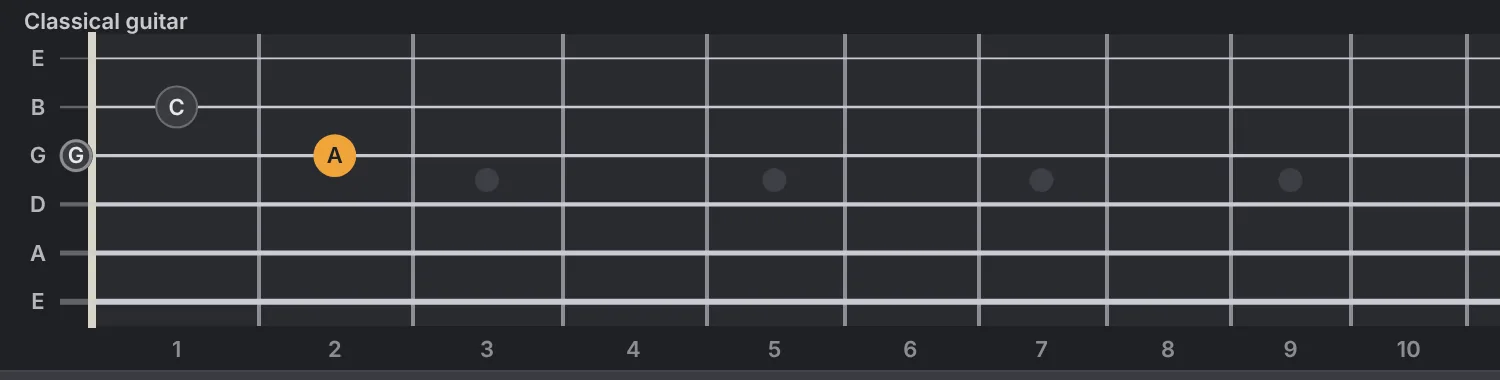
Every fret up a string is a semitone up, so the 5th fret of the low E is A, the same note as the open A string; that is also how you tune by ear, except the B string, which matches the 4th fret of the G.
The common tunings
| Tuning | Strings, low to high | What it is for |
|---|---|---|
| Standard | E A D G B E | The reference. Every other tuning is described as a change from it, and nearly all printed tab assumes it. |
| Drop D | D A D G B E | Only the low E string goes down a whole step. Power chords on the bottom three strings become one finger across, and songs in D get a low root. |
| DADGAD | D A D G A D | Both E strings and the B string come down. The open strings make a D sus4 drone, which is why Celtic and folk fingerstyle lives here. |
| Open G | D G D G B D | Strumming the open strings gives a G major chord. Slide guitar, Delta blues and five-string rock riffing use it. |
| Open D | D A D F♯ A D | The open strings sound a D major chord. Slide and fingerstyle blues; the same shapes as open E, with less string tension. |
| Open E | E B E G♯ B E | Open D moved up a whole step: an E major chord on the open strings. Brighter and tighter than open D; used for slide. |
| Half-step down | D♯ G♯ C♯ F♯ A♯ D♯ | Every string a semitone lower. Standard shapes sound in E♭; a lot of rock was recorded this way, and it helps singers. |
| Whole-step down | D G C F A D | Every string a whole step lower. Standard shapes sound in D: heavier and looser, common in blues and rock. |
| Drop C | C G C F A D | Whole-step down, then the low string a further whole step. A low C under drop-D shapes, for metal. |
| Tuning | Strings, low to high | What it is for |
|---|---|---|
| Standard | E A D G | The four lowest strings of a guitar, an octave down. |
| Drop D | D A D G | Low E down to D, as on guitar. |
| 5-string | B E A D G | A low B string under the standard four. |
| Tuning | Strings, low to high | What it is for |
|---|---|---|
| Standard | G C E A | Re-entrant: the fourth string is higher than the third, so the tab reads top to bottom as A E C G. |
How a tuning changes the tab
The fret numbers in tab are relative to whatever the strings are tuned to, so the same tab means different notes in a different tuning. A tab written in drop D played in standard tuning has every note on the low string a whole step sharp. This is why a tab always says its tuning at the top, and why you should check it before you start learning a riff that sounds wrong.
In the SimpleNotation editor, the tuning belongs to the instrument: open the Instruments dialog, pick a preset or set each string, and set a capo if you use one. Changing the tuning keeps the notes on the staff where they are and re-fingers the tab for the new strings, so a piece written in standard can be shown in drop D with the frets worked out for you; playback and the fretboard panel follow the new tuning. Text tab export writes the tuning on the first line; Guitar Pro files bring their tuning with them.
Which tuning for which job
- Learning songs from tab: whatever the tab says, usually standard, half-step down for a lot of rock and metal records.
- Playing for a singer who wants it lower: half-step or whole-step down keeps your shapes and drops the key; a capo does the opposite.
- Riffs with a low root and one-finger power chords: drop D, and drop C if the song is heavier still.
- Fingerstyle with drones: DADGAD for Celtic and folk, open D or open G for blues and slide.
- Bass: the four low strings of a guitar an octave down, E A D G; a 5-string adds a low B.
Questions
What are the notes of standard guitar tuning?
E A D G B E, from the thickest string to the thinnest. The strings are a fourth apart except G to B, which is a major third.
What is drop D tuning?
Standard tuning with the low E string lowered a whole step to D: D A D G B E. The three lowest strings then make a power chord with one finger across them.
Does the tab change when I change tuning?
Yes. Fret numbers are counted from the open string, so the same numbers give different notes in a different tuning. A tab is written for one tuning, named at the top; in an editor the tab is re-fingered for you when the tuning changes.
Is half-step down the same as a capo?
The opposite. Half-step down lowers every string a semitone, so the same shapes sound a semitone lower; a capo on the 1st fret raises them a semitone.
Which tunings does the editor have?
Guitar: Standard, Drop D, DADGAD, Open G, Open D, Open E, Half-step down, Whole-step down, Drop C, plus any custom tuning string by string. Bass: standard, drop d, 5-string. Ukulele, mandolin, banjo, 7-string, 12-string, baritone and lap steel have their own.