Home › Learn › Transposing and capos
How to transpose guitar tab (and when to use a capo)
Transposing means moving every note up or down by the same distance. On guitar there are three ways to do it: add the same number to every fret, put on a capo and keep the frets, or let the software move the notes and work out new fingerings. Here is when each one is right.
Updated October 25, 2026 · by the SimpleNotation team
Semitones: the unit of transposing
One fret is one semitone. Moving a riff from the 5th fret to the 7th on the same string raises it two semitones, a whole step. The names of the intervals you will meet: a minor third is 3 semitones, a major third 4, a perfect fourth 5, a perfect fifth 7, an octave 12. So “up a fourth” on a tab means add 5 to every fret, or capo at 5.
Way 1: add to every fret
For a single-line riff with no open strings, add the same number to every fret and play it in the same shape, higher up the neck. It stops working when you hit an open string (0 cannot go lower) or run out of neck, and when a chord shape stops being playable because the open strings were part of it.
Original (A minor pentatonic, 5th fret)      Up a whole step (B minor, 7th fret)
e|-----------5-8---|                        e|-----------7-10--|
B|-------5-8-------|                        B|-------7-10------|
G|---5-7-----------|                        G|---7-9-----------|
D|-----------------|                        D|-----------------|
A|-----------------|                        A|-----------------|
E|-----------------|                        E|-----------------|
Way 2: use a capo and keep the frets
A capo moves the nut. Clamp it on the 2nd fret and every open shape sounds a whole step higher while you play exactly the same frets, counted from the capo. This is how most singers’ guitarists change key: the song is written in G shapes, the capo decides whether it comes out in G, A, B♭ or C. The chart gives the sounding chord for each open shape:
| You play the shape | C | G | D | A | E | Am | Em | Dm |
|---|---|---|---|---|---|---|---|---|
| Capo 1 | C♯ | A♭ | E♭ | B♭ | F | B♭m | Fm | E♭m |
| Capo 2 | D | A | E | B | F♯ | Bm | F♯m | Em |
| Capo 3 | E♭ | B♭ | F | C | G | Cm | Gm | Fm |
| Capo 4 | E | B | F♯ | C♯ | A♭ | C♯m | A♭m | F♯m |
| Capo 5 | F | C | G | D | A | Dm | Am | Gm |
| Capo 6 | F♯ | C♯ | A♭ | E♭ | B♭ | E♭m | B♭m | A♭m |
| Capo 7 | G | D | A | E | B | Em | Bm | Am |
Read it as: with the capo on fret 3, a G shape sounds as B♭, an Am shape as Cm. To find a capo position for a song, look along the row for the key you want and see which shapes you would have to play.
Way 3: let the editor transpose
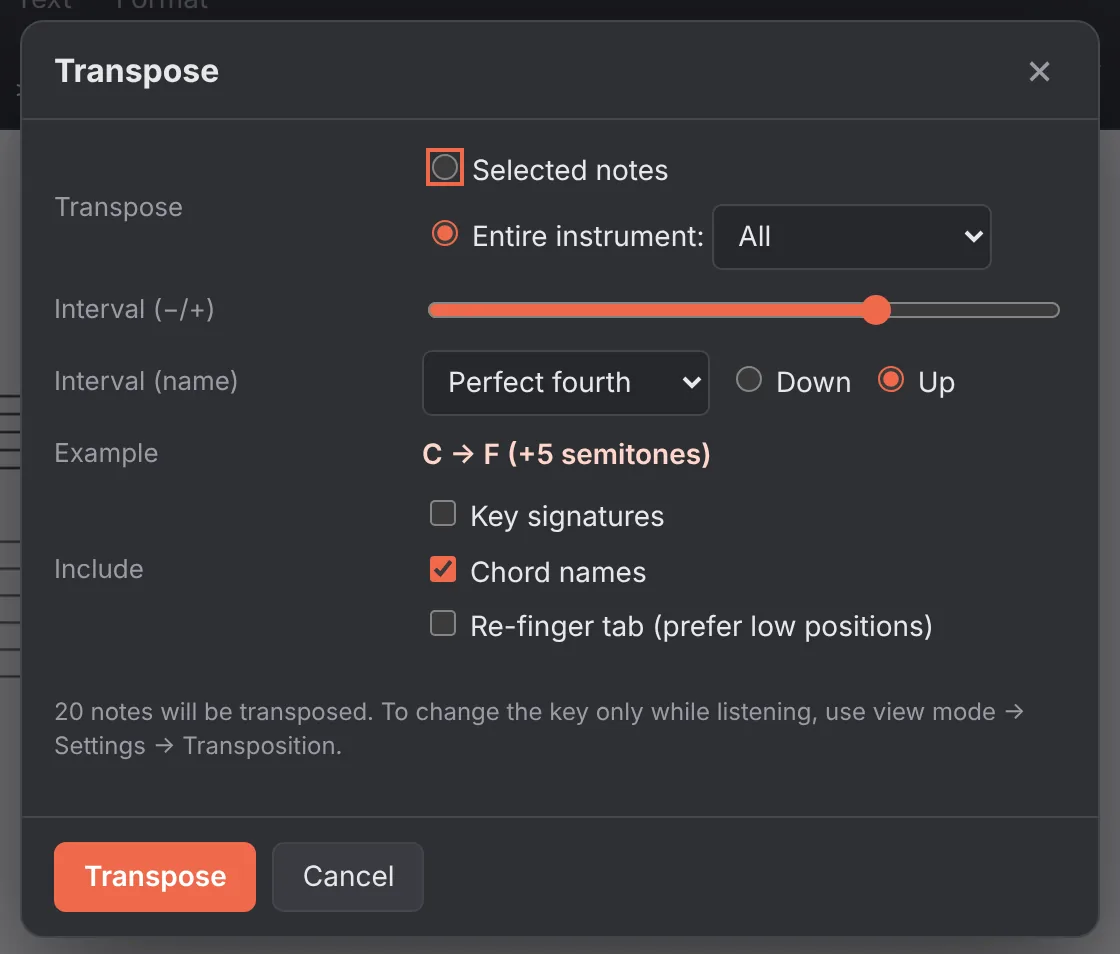
When the piece uses chords and open strings, transposing by hand means re-fingering everything. In SimpleNotation, open Transpose from the Notes tab of the ribbon or from the command search (Ctrl+K), choose the interval and the direction, and the editor moves every note, changes the key signature and the chord names if you ask it to, and chooses new strings and frets so the tab stays playable. Notes are stored as spelled pitches, so a B♭ moved up a fourth becomes E♭, not D♯, and the notation comes out the way a musician would write it.
The capo is a setting of the instrument, not a transposition: set it in the Instruments dialog, and the editor keeps the sounding pitches and re-fingers the tab relative to the capo, so the frets you see are the frets you play.
Which way, when
- A riff or solo without open strings: add to the frets, or just move your hand.
- A strummed or fingerpicked song for a singer: capo. The shapes and the open-string ring stay the same.
- A full arrangement, or a change to notation for another instrument: transpose in the editor and let it re-finger. Check a few bars afterwards; Alt+↑ and ↓ move a note to another string if you prefer a different position.
- Playing with a singer who wants “a bit lower”: half-step or whole-step down tuning does what a negative capo would; see guitar tunings.
Questions
How many frets is a whole step?
Two. One fret is a semitone (half step); two frets are a whole step. An octave is twelve frets.
Does a capo change the key?
Yes. The shapes you play stay the same, but every note sounds higher by one semitone per capo fret. A G shape with the capo on the 2nd fret sounds as A.
Can I transpose a tab with open strings by adding to the frets?
Only upwards, and only until a chord shape stops being playable. Open strings have no lower fret to go to, so transposing down needs a different fingering or a lower tuning. An editor that re-fingers handles this.
Why does the transposed notation show E♭ and not D♯?
Because the notes are moved as spelled pitches, by interval, not as fret numbers. Up a perfect fourth from B♭ is E♭ by letter name; D♯ is the same sound written in a way that does not fit the key.
Can I transpose only one instrument in a score?
Yes. The Transpose dialog can apply to the selection, the current instrument or the whole score, so a guitar part can move while the vocal line stays.