Home › Learn › How to read guitar tab
How to read guitar tab
Tab tells you where to put your fingers: which string, which fret, in what order. If you can count to 24 you can read it. This guide covers the lines, the numbers, chords, rhythm, and the symbols you will meet in most tabs, with examples you can play straight away.
Updated October 25, 2026 · by the SimpleNotation team
The six lines are the six strings
A tab staff has one line per string. The bottom line is the thickest string, the low E, and the top line is the thin high E. That is the guitar as you see it when you look down at it while playing, so the top line is the string closest to the floor. Text tab usually labels the lines at the left:
e|-----------------------------------|   1st string (thinnest, high E)
B|-----------------------------------|   2nd
G|-----------------------------------|   3rd
D|-----------------------------------|   4th
A|-----------------------------------|   5th
E|-----------------------------------|   6th string (thickest, low E)
Bass tab has four lines (five for a five-string), ukulele four, mandolin and banjo their own counts. The rule is the same: bottom line, lowest string.
The numbers are frets
A number on a line means: play that string, pressed down at that fret. 0 means the open string, nothing pressed. 1 is the first fret, up by the nut; 12 is the fret with the double dot. Read from left to right, one number after another. Here is a C major scale going up, one note at a time, then a C chord:
e|-----------------------------0---|
B|---------------------0---1---1---|
G|-----------------0-2---------0---|
D|---------0-2-3-------------------|
A|---3-------------------------3---|
E|---------------------------------|
Play it slowly: third fret on the A string, open D, second fret D, third fret D, open G, and so on. Numbers that are higher up the neck, like 12 or 15, are played as written; tab never tells you which finger to use, so pick fingers that keep your hand still.
Numbers stacked on top of each other are a chord
When several numbers sit in the same column, play them at the same time: a chord or a two-note interval. The last column of the example above is a C major chord, strummed from the A string down. A column with only two numbers is a double stop, two strings at once.
    G          D          Em         C
e|--3----------2----------0----------0------|
B|--0----------3----------0----------1------|
G|--0----------2----------0----------0------|
D|--0----------0----------2----------2------|
A|--2---------------------2----------3------|
E|--3---------------------0-----------------|
Many tabs also write the chord name above the column, as here. A string with no number in the column is not played, or is muted with a finger that is already in the chord shape.
Rhythm: what tab does not tell you
Plain text tab shows the order of notes, and the spacing gives a rough idea of timing, but it does not say how long each note lasts. That is why most people learn a riff from a recording and use the tab to find the frets. Printed tab from notation programs fixes this in two ways: stems and beams under the numbers, like the stems in standard notation, or a staff of standard notation above the tab that carries the rhythm while the tab carries the frets. SimpleNotation does both: every tab staff has rhythm stems, and the notation staff above it is always in step with the tab.
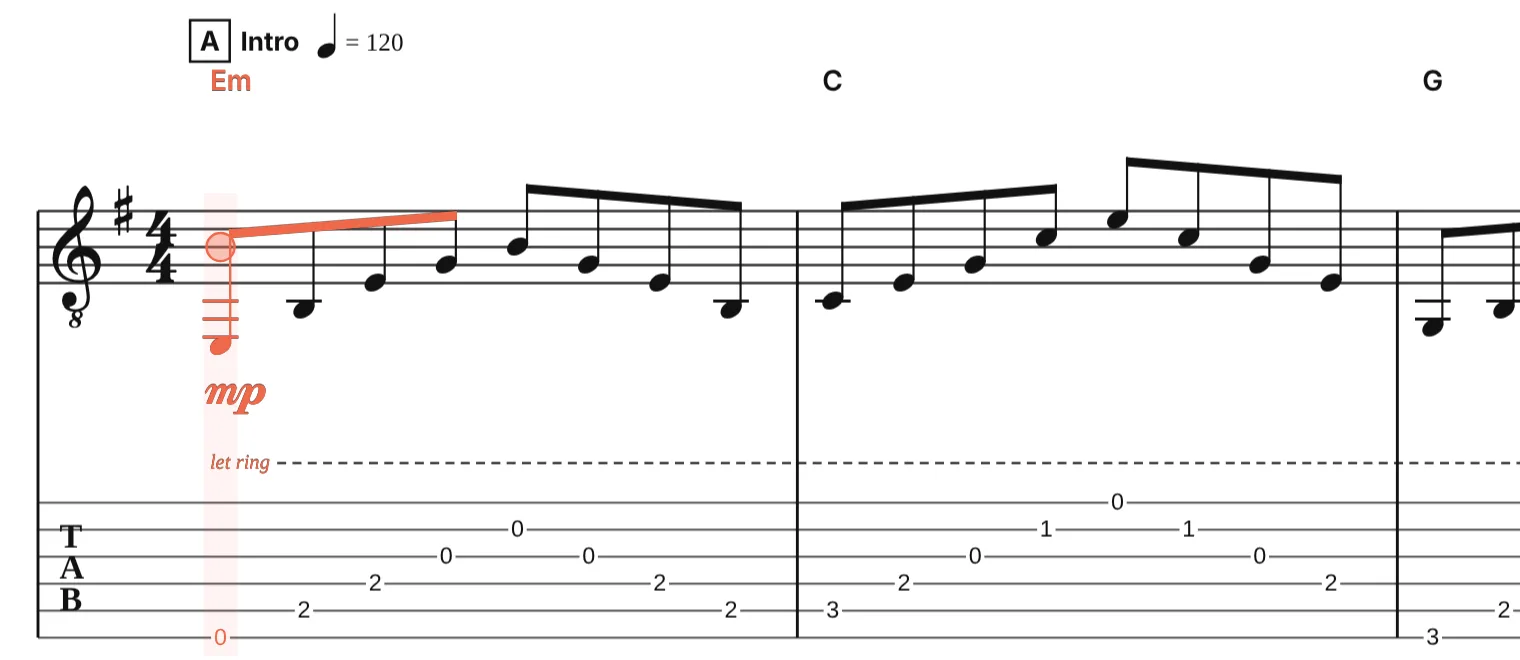
The symbols between the numbers
Letters and signs between two numbers tell you how to get from one note to the next. The most common ones:
- 5h7
- Hammer-on: pick the 5th fret, then press the 7th without picking again.
- 7p5
- Pull-off: the reverse, pick the 7th fret and pull the finger off to sound the 5th.
- 5/7 and 7\5
- Slide up or down from the first fret to the second, keeping the string pressed.
- 7b9
- Bend the string at the 7th fret until it sounds like the 9th fret.
- 7~
- Vibrato.
- x
- A dead or muted note: a percussive click with no pitch.
- PM
- Palm mute, usually written above the tab with a dashed line showing how long it lasts.
The full list, with harmonics, tapping, ghost notes and what each symbol looks like in notation, is on guitar tab symbols explained.
Tab and standard notation together
Tab tells you where; notation tells you what. The staff above the tab names the pitch, shows how long each note lasts, where the beat falls, which notes are tied, and the key the piece is in. Once you can read tab, the staff above it is the easiest way to pick up rhythm reading, because every note on it has a fret number right underneath. The guide on note values and time signatures covers the rhythm half.
Try it with a real tab
The demo score opens in the editor with notation and tab together. Press the play button and watch the cursor move through the tab while you hear it; hold the mouse over any toolbar button to see what it does. The public scores include Greensleeves, Amazing Grace and other easy pieces with full tab you can slow down and loop.
Questions
Which line is the low E string in guitar tab?
The bottom line. Tab is drawn as you see the guitar looking down while you play: the thick low E string at the bottom, the thin high E string at the top.
What does 0 mean in guitar tab?
An open string: play the string without pressing any fret. A 1 is the first fret, next to the nut.
How do I know the rhythm from a tab?
Plain text tab does not show it; you take the timing from the recording or from stems written under the numbers. Tab exported from notation software, including SimpleNotation, has rhythm stems on the tab and a notation staff above it that shows the exact note values.
Do I have to use the fingers the tab implies?
Tab says which fret, not which finger. Use the fingers that keep your hand in one position; tabs sometimes add fingering numbers (1 to 4) below the notes when it matters.
Can I read bass, ukulele or banjo tab the same way?
Yes. The number of lines matches the number of strings, the bottom line is the lowest string, and the numbers are frets. Ukulele tab reads top to bottom as A E C G because its fourth string is tuned higher than the third.