Home › Learn › Guitar tab symbols
Guitar tab symbols explained
The letters and signs between the fret numbers are the techniques: how you get from one note to the next. This is the list you will meet in text tab and in printed tab from Guitar Pro, Ultimate Guitar and notation programs, with how each is played and what it looks like in standard notation.
Updated October 25, 2026 · by the SimpleNotation team
Legato: hammer-ons, pull-offs and slides
e|-------------------------------------------------|
B|-------------------------------------------------|
G|---5h7---7p5---5h7p5---5/7---7\5---5/7\5--------|
D|-------------------------------------------------|
A|-------------------------------------------------|
E|-------------------------------------------------|
- h
- Hammer-on. Pick the first note, then bring a finger down hard on the higher fret so it sounds without picking. In notation: a slur (curved line) joining the two notes, often with an “H”.
- p
- Pull-off. Pick the higher note, then pull the finger off sideways so the lower fret (or open string) sounds. Also a slur in notation, sometimes marked “P”.
- 5h7p5
- Chained: one pick, three notes. Hammer-ons and pull-offs in a row are called legato playing.
- /
- Slide up. Pick the first fret and slide the finger up to the second, keeping the string pressed so the pitch glides. A straight line between the notes in notation.
- \
- Slide down. The same, towards the nut. A slide with no starting number (/7) comes from nowhere in particular: start a few frets below and slide in.
Bends, releases and vibrato
e|--------------------------------------------------|
B|---7b9---7b9r7---9r7---7b(8)---7~~~---7b9~--------|
G|--------------------------------------------------|
D|--------------------------------------------------|
A|--------------------------------------------------|
E|--------------------------------------------------|
- b
- Bend. Pick the note at the first fret and push the string across the fretboard until it reaches the pitch of the fret after the “b”: 7b9 is a whole-step bend (two frets). 7b8 is a half-step bend. Some tabs write the amount instead: “full”, “1/2”, “1/4”.
- r
- Release. Let the bend back down to the fret after the “r”, still ringing. 7b9r7 is bend up, then back down.
- 9r7
- Pre-bend and release. Bend the string before picking, pick, and release down to the written fret.
- ~
- Vibrato. Wobble the pitch by rocking the finger or bending slightly back and forth. More tildes, or “~~~”, means wider or longer vibrato. A wavy line in notation.
Muting and percussion
      PM------------|
e|----------------------------------|
B|----------------------------------|
G|----------------------------------|
D|----------------------------------|
A|------------------x---x---(5)-----|
E|--0-0-0-0-0-0-0-0-----------------|
- PM
- Palm mute. Rest the edge of the picking hand on the strings at the bridge while picking, for a short, chunky sound. The dashed line shows how long it lasts. In notation: “P.M.” with a dashed line.
- x
- Dead note. Touch the string with the fretting hand without pressing it down and pick: a click with no pitch. An X note head in notation. A whole column of x’s is a percussive strum.
- (5)
- Ghost note. Played quietly, barely sounding; the number in brackets. Also used for a note that is still ringing from a tie across a bar.
Harmonics, tapping and the picking hand
e|---<12>---<7>---[19]---t12p5h7----------------|
B|----------------------------------------------|
G|----------------------------------------------|
D|----------------------------------------------|
A|----------------------------------------------|
E|----------------------------------------------|
- <12>
- Natural harmonic. Touch the string lightly directly over the fret wire (12, 7 or 5 are the clear ones) and pick: a bell-like note. A diamond note head in notation, often marked “Harm.”.
- [19]
- Artificial (pinch) harmonic. Fret the note and touch the string an octave higher with the picking hand, or catch it with the thumb on the pick stroke. Marked “A.H.” or “P.H.” in notation.
- t
- Tap. Sound the fret by hammering with a finger of the picking hand, then usually pull off to a note held by the fretting hand.
- ∏ and V
- Down-stroke and up-stroke of the pick, written above the notes in printed tab. Arrows (↑ ↓) next to a chord mean strum up or down.
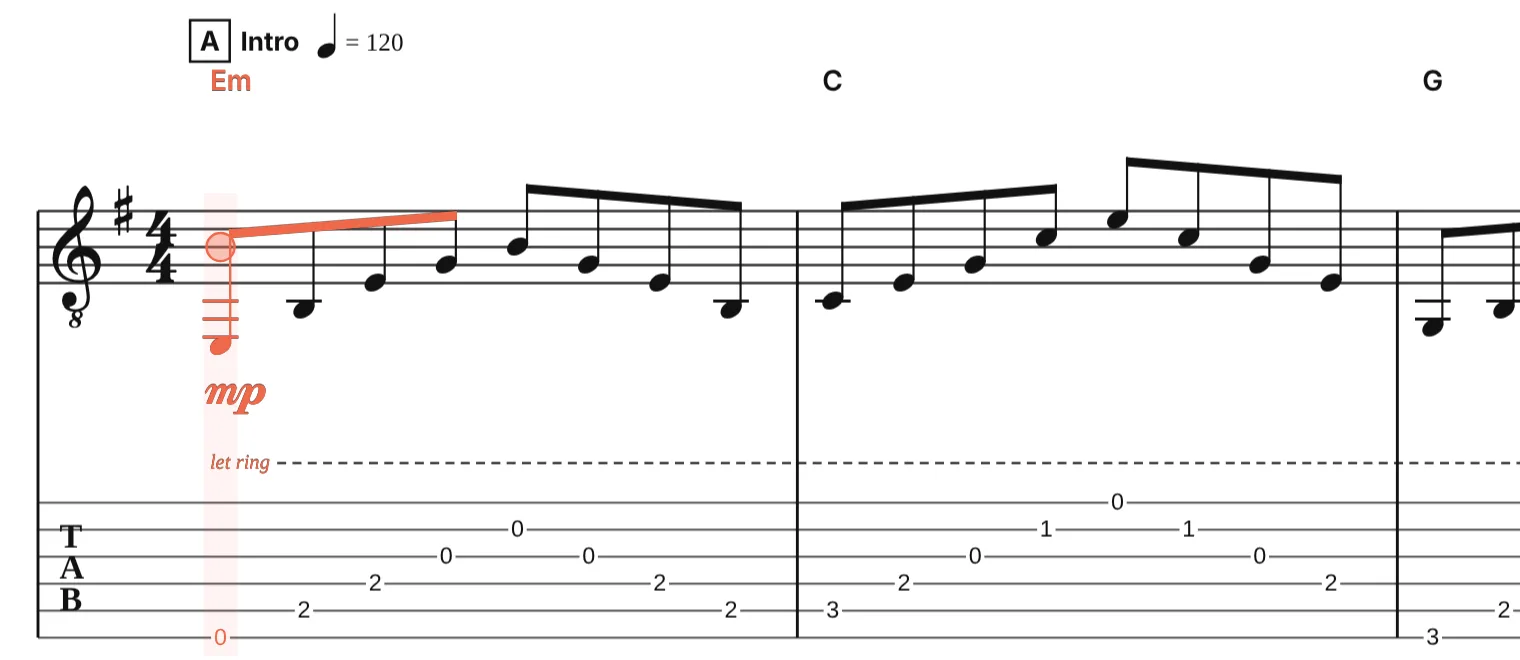
- let ring
- Hold each note so it rings into the next, as in a fingerpicked arpeggio. A dashed line shows how far it lasts.
Other things you will see
- Numbers above 12 are simply high frets; 24 is the last fret on most electrics.
- A fret number with a dot after it in some text tabs means a staccato, short note.
- Repeat signs |: and :| mean play the bars between them again; “x2” after a riff means the same.
- Capo 2 (or any number) at the top means put a capo at that fret and read every number relative to it; see transposing and capos.
- Tuning: D A D G B E at the top means retune first; see guitar tunings.
Writing these symbols yourself
In the SimpleNotation editor, every technique is one key while the cursor is on a note in the tab: H hammer-on or pull-off, S slide, B bend, V vibrato, X dead note, P palm mute, Y harmonic, I let ring. Tapping, slap, pop, pick strokes and ghost notes are in the palette and the command search (Ctrl+K). The notation staff above draws the slur, the bend arrow or the X head at the same time, and playback performs the technique so you can hear whether you wrote what you meant. Text tab export writes exactly the letters on this page.
Questions
What does h mean in guitar tab?
A hammer-on: pick the first note and press a higher fret with another finger so the second note sounds without picking. 5h7 is pick the 5th fret, hammer onto the 7th.
What does p mean in guitar tab?
A pull-off, the opposite of a hammer-on: pick the higher fret and pull the finger off so the lower fret or the open string sounds. 7p5 is pick 7, pull off to 5.
What is the difference between / and \ in tab?
Both are slides. / slides up to a higher fret, \ slides down to a lower one, keeping the string pressed so the pitch glides between them.
What does b and r mean in tab?
b is a bend: push the string until it sounds like the fret written after the b. r is a release: let the bend back down to the fret after the r. 7b9r7 is bend the 7th fret up a whole step, then release it.
What does x mean in guitar tab?
A dead or muted note. Rest the fretting fingers on the string without pressing and pick, for a pitchless click. A column of x’s is a muted strum.
What does PM mean in guitar tab?
Palm mute: rest the side of your picking hand on the strings next to the bridge while picking. The dashed line after PM shows which notes are muted.