Home › Learn › Note values and time signatures
Note values and time signatures, for guitar players
Tab tells you where the notes are. Rhythm tells you when. This is the smallest amount of notation you need to read the rhythm stems on a tab or the staff above it: how long each note lasts, how bars are counted, and what the numbers at the start of a piece mean.
Updated October 25, 2026 · by the SimpleNotation team
The beat, and the bar
Music is counted in beats: the steady pulse you tap your foot to. Beats are grouped into bars (measures), with a bar line between them. In most songs you count “one two three four” and the next bar starts on the next “one”. The time signature at the start says how the bars are counted.
Note values
Each note value lasts half as long as the one before it. In 4/4 time, where a quarter note is one beat:
| Note | Looks like | Beats in 4/4 | Count |
|---|---|---|---|
| Whole note | Hollow head, no stem | 4 | 1 2 3 4 |
| Half note | Hollow head with a stem | 2 | 1 2 |
| Quarter note | Filled head with a stem | 1 | 1 |
| Eighth note | Filled head, stem with one flag or beam | ½ | 1 and |
| Sixteenth note | Two flags or beams | ¼ | 1 e and a |
On a tab staff with rhythm stems, the stems and beams under the numbers follow the same rule: a plain stem is a quarter note, one beam an eighth, two beams a sixteenth, and a number with no stem is a half or whole note. In the editor, + makes the current note one value shorter and − one value longer.
Dots, ties and rests
- A dot after a note adds half its value: a dotted half note is 3 beats, a dotted quarter 1½. . in the editor.
- A tie is a curved line joining two notes of the same pitch into one longer note; the second is not picked again. It is how a note lasts across a bar line. L ties a note to the one before it.
- Rests are silences with the same values as notes: a whole rest hangs from a line, a half rest sits on one, a quarter rest is the squiggle, eighth and sixteenth rests have flags. R writes a rest.
- Triplets fit three notes into the time of two: three eighth-note triplets in one beat, counted “1 trip-let”. The 3 above the group marks them. / in the editor.
Time signatures
The two numbers at the start of the staff: the top one is how many beats in a bar, the bottom one which note value is the beat (4 = quarter note, 8 = eighth note).
| Signature | Count | Feel |
|---|---|---|
| 4/4 (common time, also written C) | 1 2 3 4 | Almost all rock, pop, blues and folk. The default in the editor. |
| 3/4 | 1 2 3 | Waltz time: Greensleeves, Amazing Grace, Silent Night. |
| 2/4 | 1 2 | Marches and polkas; a quick two. |
| 6/8 | 1 2 3 4 5 6, felt as two groups of three | Lilting: House of the Rising Sun, many Irish tunes, slow blues. Two main beats per bar, each divided in three. |
| 12/8 | Four groups of three | Slow blues shuffles. |
A song may start with a partial bar, a pickup, when the melody begins before the first downbeat; it does not count as bar one. The editor has a pickup bar setting on the Bars tab, and the time signature can change at any bar.
Swing and shuffle
In blues, jazz and a lot of rock, pairs of eighth notes are played long-short instead of evenly, like the first and third notes of a triplet. It is written as plain eighth notes with “swing” or a “♪♪ = triplet” mark at the start. The editor has a triplet feel setting per bar so playback swings while the notation stays plain.
Hearing it
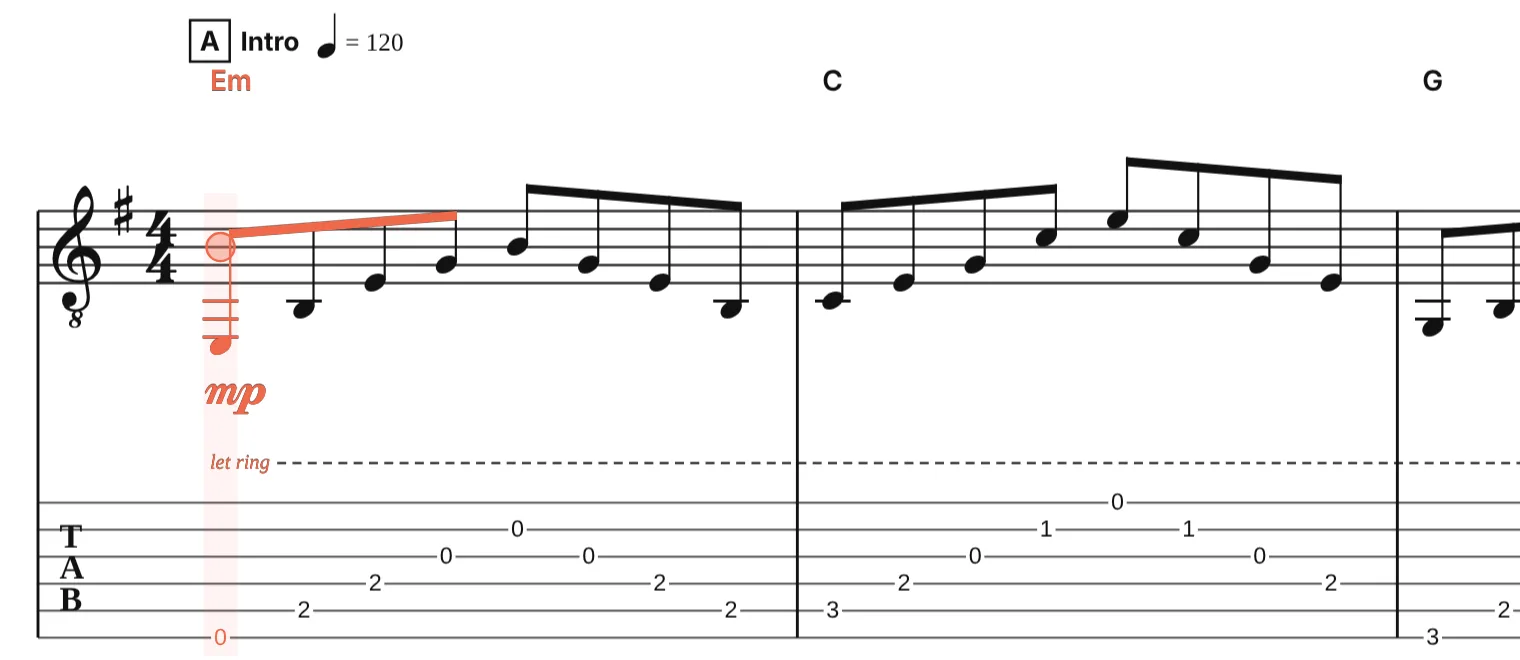
The quickest way to learn rhythm reading is to see and hear at once. In the demo score, turn the metronome on, press Space, and watch the cursor move through the notation and the tab together; slow it down if the eighth notes go by too fast. Type a bar yourself with +, − and . and play it back to check that it adds up to the bar; the editor shows when a bar is overfull.
Questions
How many beats is a quarter note?
One beat in 4/4, 3/4 and 2/4 time, where the bottom number 4 means the quarter note is the beat. In 6/8 the eighth note is counted as the beat, so a quarter note is two.
What does 4/4 mean?
Four beats in every bar, and the quarter note is the beat. It is also called common time and written as a C.
What is the difference between 3/4 and 6/8?
Both have six eighth notes in a bar, but 3/4 is felt as three beats of two eighths (a waltz), and 6/8 as two beats of three eighths (a lilt or jig).
What does a dot after a note do?
It adds half the note’s value. A dotted quarter note lasts one and a half beats; a dotted half note lasts three.
Can I see the rhythm on a tab?
Yes, when the tab has rhythm stems under the numbers or a notation staff above it. Plain text tab has neither, which is why it is usually learned with the recording.